Monday, February 29, 2016
Social Studies and Technology
As part of the RCSD Digital Transformation, my colleague Liza Steffen and I were asked to coordinate classroom visits and discussions between students, teachers and the Social Studies and African American studies directors with respect to the use of technology within Social Studies teaching and learning. Audra Schmitt, Director of Social Studies and Djinga St. Louis, Director of African American Studies, joined Liza and I as we met with Davin Reddington, WOIS #58 and Demetria Lawton and Charles Hall of MLK School #9.
Click here to access information from the experience!
Digital Transformation in the RCSD
The RCSD is in the early stages of "Digital Transformation." Actually, we have been deep into this transformation for at least the past five years. Up through the turn of the century, most classrooms were paper based with the ole Overhead Projector as the primary technology tool of teachers.
Approximately six years ago, I stepped out of the classroom, to support teachers and students as SMARTboards, document cameras and iPads came into use within most classrooms across the district. SMARTboards provided an interactive learning device for teachers and students to display teaching and learning. The district initially rolled out the technology in classrooms with "model classroom teachers." The hope was that these teachers would be successful and would act as leaders and turn-key technology use within their buildings. In addition to SMARTboards, teachers received teacher laptops, document cameras, Netbooks, student response systems or "clickers", training and support for all the technology. The iPads that were rolled out were part of a Kindergarten through 2nd grade initiative that provided teachers with a "technology center" for their students to use apps for learning. Lexia, Raz-Kids, and a variety of Math apps provided primary students with a tool for learning that was highly motivating.
This next wave in the RCSD Digital Transformation, I believe, is a Tsunami. Well, it's big, hopefully without the destruction of a Tsunami. The Smart Bond Act of 2014 was passed by the voters of New York. This act provides school districts across the state with funds to support with technology integration across the grade levels. The RCSD looks to begin rolling out Chromebooks, moving toward a 1:1 computing environment in grades 3-12. The technology is part of three important parts of this transformation. Technology, pedagogy and classroom management are intertwined when we speak of student success and learning. How will these three work together for teachers and students to produce a rich, high quality education for students? Stay tuned for those posts!
Wednesday, October 21, 2015
George Carlin and the "Stuff" in our Classrooms
Your Classroom’s Feng Shui and George Carlin
By Pete Hilling
1,200 square feet. Sounds like a lot of space. It may even look like a decent sized room, if it’s an empty one. Thirty feet by forty feet are the average classroom dimensions. How teachers use that space, is both a major factor in how well teachers teach, and how well students learn. With the introduction of SMARTboards and document cameras over the past five years, analyzing, planning, organizing and ongoing tweaking of the space teachers and students live in during the school day, is a must. The type and amount of furniture, teaching materials, or “stuff” to quote the great George Carlin, and technology in your classroom is a topic that requires careful thought, creativity and a new way of using the physical and digital spaces in classrooms. Setting up a classroom is a personal matter; one that every teacher undergoes at the beginning of each year and will often revisit during the brief respite on holidays. How many desks, tables and chairs are needed in a given space?
Teachers traditionally review the physical needs of their students in order to gain a better understanding of the classroom layout or design for optimal, safe teaching and learning. Some information is dictated by the number of students on the roster, the size and age of students (Review the lists in Chip Woods Yardsticks for a keen understanding of the physical, emotional and cognitive needs of each age 4-14), and the needs of students with unique physical limitations. Students and teachers must be able to move around the room in a relatively safe, easy manner. The careful planning for student and teacher movement from arrival, through centers or stations, to dismissal, will minimize the number of collisions, conflicts, and time lost transitioning throughout the school day. The careful selection of the amount and style of furniture in the classroom goes a long way toward supporting positive classroom management. Too many tables, desks, file cabinets, bookshelves, etc. and you have a maze that slows down movement from point A to B, detracting from teaching and learning. With the increase or addition of technology comes a change in how furniture is used, or not used in the classroom.
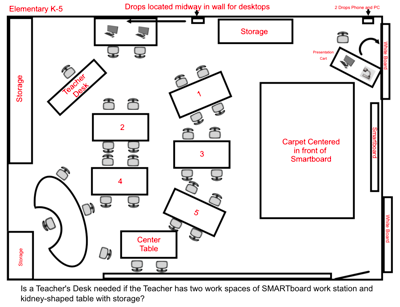
Classroom furniture has undergone major changes with the introduction of the SMARTboard. As SMARTboards were mounted on the classroom walls, the teacher workspace was redefined. The teacher laptop, and if possible document camera and other teacher tools, needs to be located near the SMARTboard. These pieces of technology could fit on a teacher’s “traditional desk,” but many teachers have moved away from using a teacher desk, to using a workspace, such as a table or presentation cart for these technologies. Do all students need a desk, chair, or table, if they work more comfortably on the floor given their developmental need to stretch or lay down when thinking, reading or writing? Is there a need for a file cabinet? With more teacher documents, maps and artifacts being digitized and able to be displayed on a SMARTboard with a click of a mouse, teachers are rethinking the need for the file cabinet (Just have to remember to back the work up on your “H” or external hard drive unless you have drank the Google-Aide!). If the file cabinet has gone the way of the overhead, it may be time to place the cabinet in storage and make room for a larger reading center or collaborative space where small numbers of students can work comfortably together at a table or on the floor. While George Carlin was razzing us all about the amount of “stuff” in our homes, his humor can easily be applied to the classroom. The classroom is home for teachers and students 188 of the 365 days in a school year. Careful consideration given to the amount of classroom “stuff” and its place, is an important factor in strong teaching and learning. If you are room-design challenged, there is almost always at least one teacher in your building who either appreciated George Carlin or has a classroom Feng Shui skill worthy of tapping.
Wednesday, February 25, 2015
OK, so I haven't posted in a while. Life has been busy! I am now becoming a blogaholic (I think;). I just read a couple student blogs from DS1 and the quality and variety is brilliant! For those of you catching up and just starting to create your blogs, we (Liza Steffen, Sheldon Cox, Ryan Goff, Brian Bizzigotti and myself) will be out to support you. We will also show you some of the other blogs so you can evaluate what others are doing and how it goes in blogland. Stay tuned and keep creating, posting and sending me your blog info.
Subscribe to:
Posts (Atom)